U2
TAMU Guessr
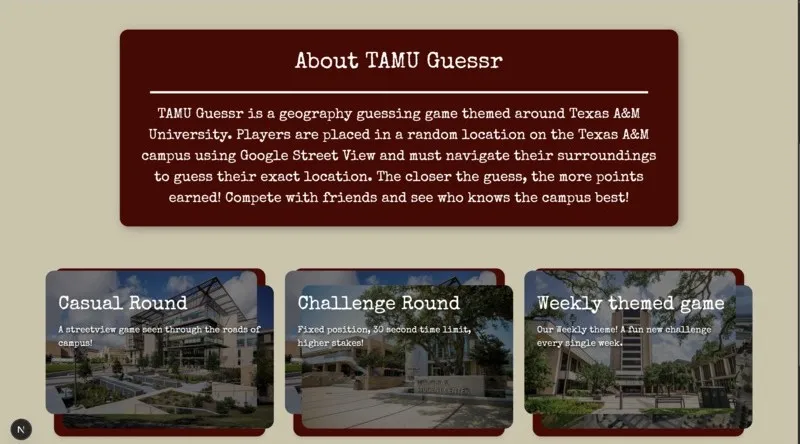
A GeoGuessr-style game for the Texas A&M campus. You are dropped somewhere in Street View and have to pin where you are. Built in 24 hours at HowdyHack 2025, where it took 2nd place overall out of 149 developers.
- Year
- 2025
- Role
- Full-stack developer on a team of three
- Stack
- Next.js
- React
- TypeScript
- Tailwind CSS
- Google Maps API
- Node.js
Texas A&M covers more than 5,000 acres, and most students only ever see a small part of it. TAMU Guessr borrows the idea behind GeoGuessr to fix that: it places you at a random spot on campus in Google Street View, you look around, and you drop a pin on the map where you think you are. The closer the guess, the more points you earn.
I built it with Hezekiah Gitenyi and Andrew Blair in a 24-hour sprint at HowdyHack 2025. It won 2nd place overall out of 149 competing developers.
What I built
- Set up the full-stack app in Next.js and React inside the 24-hour limit.
- Integrated the Google Maps JavaScript API for the Street View scene and the guess map, with coordinate validation and dynamic scoring based on how far off the guess is.
How it works
- Three ways to play. A casual round you can walk around in, a challenge round with a fixed position and a 30-second limit, and a weekly themed game.
- Front end. React components written in TypeScript handle the game state and every button. Next.js organises the app with file-based routing and server-side rendering.
- Styling. Tailwind CSS, with plain CSS for the global styles and custom fonts.
What was hard
Most of the stack was new to the team, so the first hours went to learning it from documentation while the clock ran. Getting Street View and the map to talk to stateful React components was the part that took the longest to get right.